Walk into any used-car yard in Balaju, or flag down a goods carrier on the Karnali Highway, and you’ll meet the same quiet truth: Nepal’s new-car showrooms have moved on, but its hardest roads still run on old Toyotas. In 2025 the country’s new-vehicle charts belong to a different cast — BYD (18.61%), Tata (15.31%) and Hyundai (12.62%) lead on import volume, and Chinese and electric brands now fill most of the top ten. Toyota? It sits outside that list, with roughly 164 units imported through mid-October. And yet the vehicle a Jumla contractor, a Mustang hotelier, or a Surkhet ambulance driver actually trusts to bring them home at the end of a bad day is often a fifteen-year-old Hilux. That gap — between what sells new and what survives — is the whole story.
At Nepali Garage we love reliable, robust, built-to-last machines. Not out of nostalgia, but because on roads like ours, durability is the feature. And no badge has earned that reputation the hard way quite like Toyota.
Built to be fixed, not thrown away
The thing that separates an old Toyota from a clever new car isn’t horsepower — it’s the assumption baked into the engineering: that this vehicle will be repaired, in the field, far from a dealership, for decades. Simple, over-specified mechanicals. A naturally-aspirated or honest turbo-diesel that tolerates bad fuel and worse roads. Bolts you can actually reach. It’s a philosophy that rewards the owner who wants to understand their vehicle — the person who’d rather know why the engine sounds different this morning than just hand over the keys and hope.
That philosophy pays off twice in Nepal. First, because the terrain is merciless — landslide detours, river crossings, monsoon potholes that swallow a wheel. Second, because the support network is everywhere. Toyota has been sold here through United Traders Syndicate for generations, which means parts move freely and there is a mechanic in nearly every district bazaar who has rebuilt a Toyota engine before and will do it again. Peace of mind, in practical terms, is knowing your car can be fixed in the town you broke down in.
The three that earned the legend
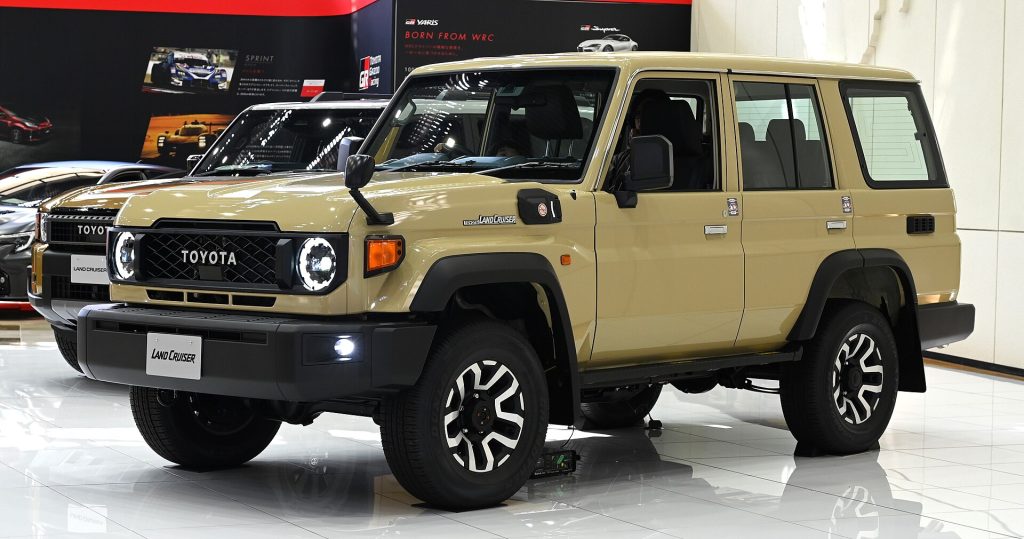
- Land Cruiser — the heirloom. Globally, Land Cruiser owners keep their trucks longer than any other Toyota — an average of around 11.4 years — and the model retains roughly 61% of its value after five years, far better than most SUVs. In Nepal it’s the default of expedition fleets, INGO field offices and mountain district administrations precisely because it doesn’t quit. People don’t sell them; they pass them down.
- Hilux — the workhorse. The Hilux’s “indestructible” reputation isn’t marketing in rural Nepal — it’s lived experience. The same pickup hauls cement up to a hill village in the morning and serves as the village’s emergency ambulance at night. It is the closest thing Nepal’s backroads have to a universal tool.
- Corolla — the people’s sedan. Decades of Corollas have quietly outlasted flashier rivals on the strength of low running costs, plentiful parts and an almost boring refusal to break. For a family that needs a car to simply work every single day, that’s the entire point.
If you’re the type who likes to turn a wrench
This is who we built Nepali Garage for. If you enjoy getting your hands dirty — or you’d at least like to understand what’s happening under the bonnet while a trusted mechanic does the heavy lifting — the old-school Toyota is the most rewarding place to start. The systems are legible. The service manuals make sense. The parts are findable. You can learn a Toyota the way you learn a tool, and that knowledge stays with you across every vehicle you ever own.
This isn’t a vote against EVs
Nepal’s electric shift is real and, in many ways, exciting — cheaper running costs and cleaner cities are worth celebrating, and we cover that side of the market closely too. But reliability isn’t a question you answer in year one; it’s the question of year ten, on a road with no signal and no service centre for 60 kilometres. The robust Toyota has been answering that question for a very long time. As Nepal’s market races toward the new, it’s worth remembering what “built to last” actually buys you — and why so many of the country’s hardest-working vehicles still wear that oval badge.
At Nepali Garage we research the cars that earn their keep. Browse the full Toyota lineup in Nepal — specs, prices and honest notes — and decide for yourself what built-to-last is worth to you.
Sources & confidence. Nepal 2025 brand market-share and import figures (BYD, Tata, Hyundai, Toyota ~164 units): customs import data reported by Meroauto and MeroMoto — official (import data). Land Cruiser value-retention (~61% over five years) and average ownership length (~11.4 years) are global figures, not Nepal-specific, via TopSpeed — estimated. Durability and parts-network observations reflect Toyota’s long-standing presence in Nepal through United Traders Syndicate — unverified / editorial. Vehicle prices and specs on our model pages each carry their own source and confidence label.