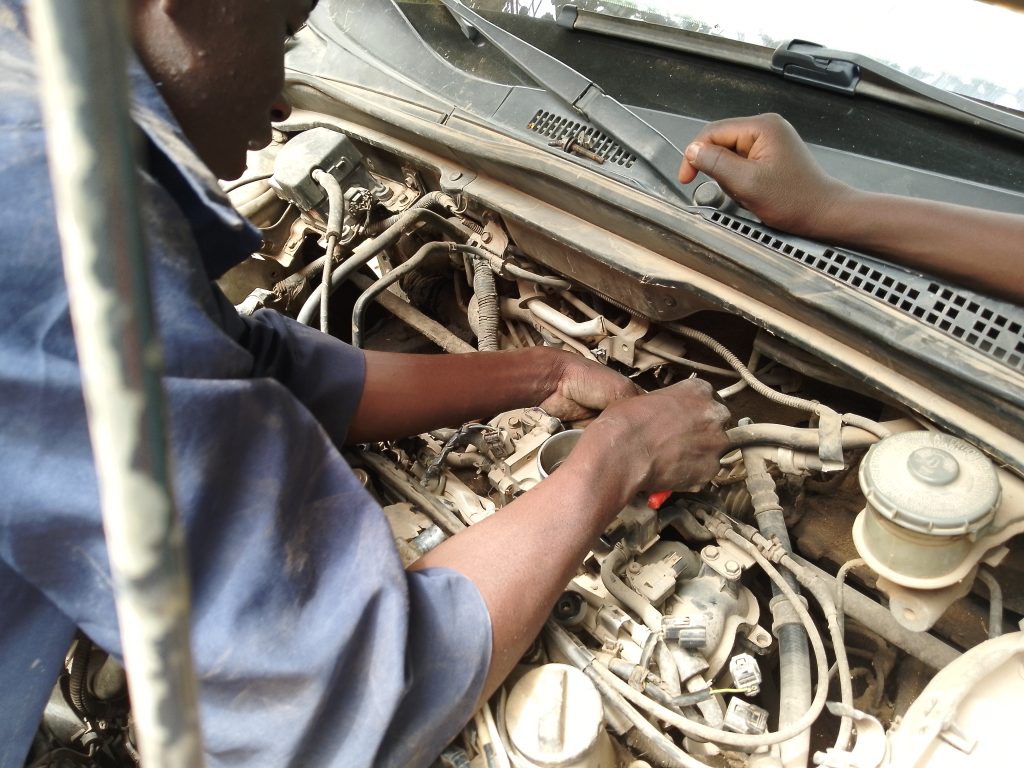
A car’s real test isn’t the showroom floor — it’s a wet night on a hill road, an hour from the nearest town, when something starts making a noise it didn’t make this morning. That’s the moment that separates a car you own from a car that owns you. And it’s why so many hands-on drivers in Nepal still quietly prize one unfashionable virtue above almost everything else: repairability. The question isn’t “how fast is it?” but “when it breaks — and everything eventually breaks — can it be fixed, here, by someone I can reach?”
At Nepali Garage we’re built around that question. We love robust, simple, fixable machines, because on Nepal’s terrain and at Nepal’s distances, repairability isn’t nostalgia — it’s the difference between a delay and a disaster.
The hidden cost of complexity
Modern cars are extraordinary, but a lot of their cleverness is sealed shut. Electronics that only a dealer’s diagnostic computer can read. Modules that are replaced, never repaired. Engines packed so tightly you can’t reach a basic part without pulling half the bay apart. In a city with a brand service centre around the corner, that’s fine. On the Karnali Highway, or a feeder road in Solukhumbu, a fault your local mechanic can’t diagnose isn’t an inconvenience — it’s a vehicle stranded a day’s drive from the part it needs.
Complexity also has a quieter cost: it shuts the owner out. When everything is a sealed black box, you can’t learn your own car. You lose the early warning — the new vibration, the changed exhaust note — that tells a hands-on owner something’s starting to go wrong while it’s still cheap to fix.
What makes a car genuinely fixable
Repairability isn’t luck; it’s a set of design choices you can actually look for:
- Simple, proven mechanicals. A naturally-aspirated engine or an honest, low-stress turbo-diesel beats a highly-strung, sensor-dense unit when you’re far from a dealer.
- A common platform. If thousands of the same model already run on Nepal’s roads, parts are in every bazaar and every mechanic has seen the failure before. Popularity is a spare-parts strategy.
- Body-on-frame, for the workhorses. For pickups and 4×4s that carry loads and take hits, a separate chassis is easier to repair and far more forgiving of abuse than a crumple-optimised monocoque.
- Parts you can source locally. A brilliant car with a three-month parts wait is, on a bad day, a paperweight. Long-established badges with deep dealer roots win here.
Why this matters more in Nepal than almost anywhere
Two facts about Nepal make repairability decisive. First, the terrain punishes machinery — gradients, river crossings, monsoon-broken tarmac, dust and altitude all accelerate wear. Second, service infrastructure is concentrated in a handful of cities, while the vehicles that work hardest are often the furthest from it. A fixable car closes that gap. It’s also why robust, simple models hold their resale value so well here: a buyer in Nepal is paying for the confidence that the car can be kept running for another decade, not just driven home from the lot.
For the owner who likes to understand the machine
You don’t have to do the work yourself to benefit from a car you can understand. Even if a trusted mechanic turns the wrenches, knowing roughly how your car works changes everything: you can describe a symptom accurately, you won’t be sold a repair you don’t need, and you’ll catch the small problem before it becomes the expensive one. A fixable car invites that kind of ownership. A sealed one quietly forbids it.
None of this is a rejection of new technology — it’s a clear-eyed view of what durability is worth on roads like ours. If you’re the kind of owner who’d rather know your vehicle than just operate it, start by choosing one built to be understood. Browse the robust, proven models we cover, each with specs, prices and honest notes, and weigh repairability as seriously as any spec on the sheet.
Sources & confidence. Resale-strength of durable, parts-rich models reflects long-standing Nepal market behaviour and the global value-retention of workhorse models such as the Land Cruiser (~61% after five years) — TopSpeed (estimated; global figure, not Nepal-specific). Nepal 2025 market context (EV/Chinese-led new-vehicle imports) via Meroauto (official — import data). Observations on terrain, parts availability and dealer-network depth are editorial, grounded in Nepal road conditions and decades of brand presence — unverified / editorial.